



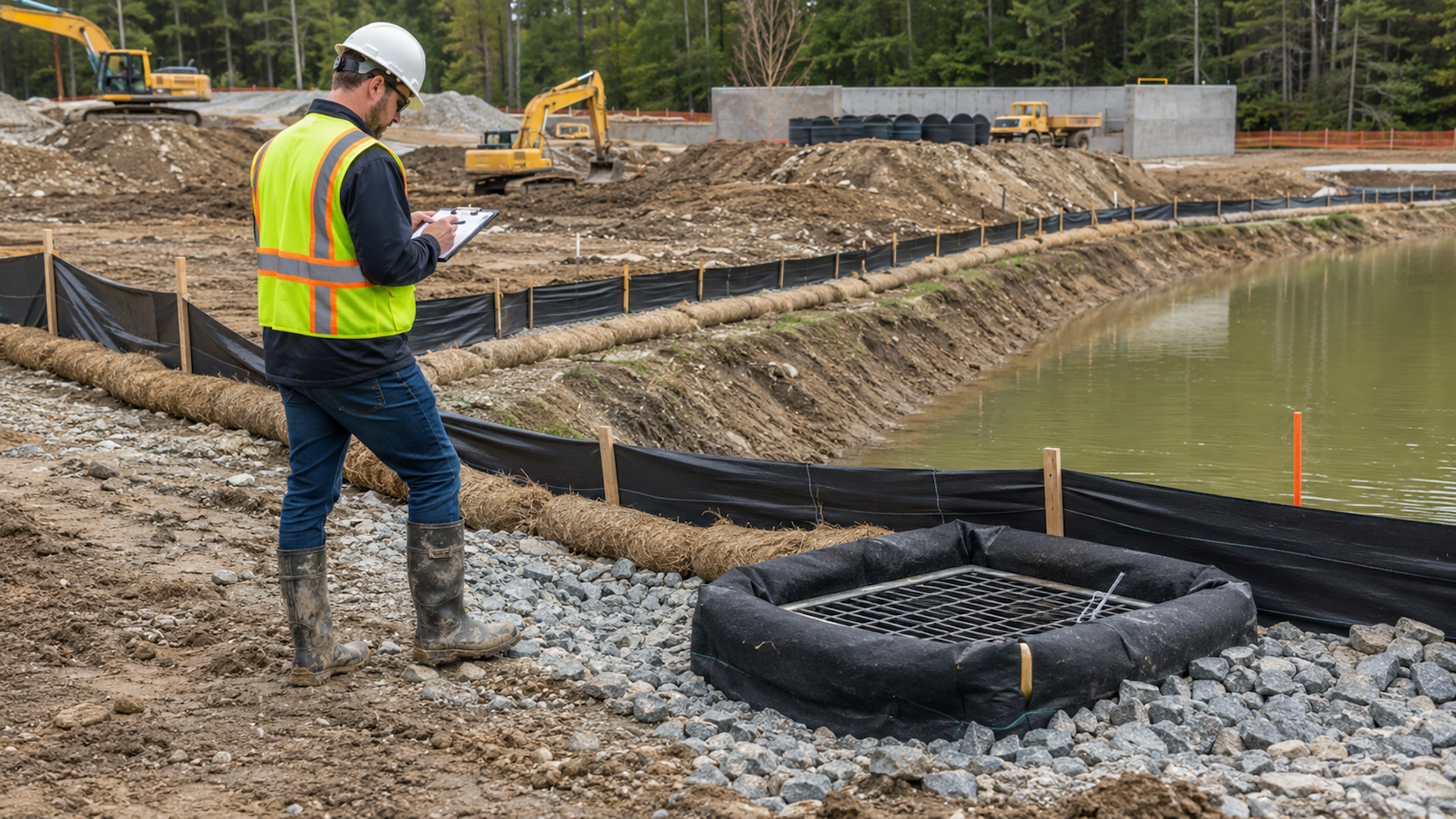
SWPPP inspections on construction sites are required at a minimum frequency of once every seven calendar days and within 24 hours of any storm event producing 0.25 inches or more of precipitation.
These are the baseline requirements under EPA’s 2022 Construction General Permit (CGP), which governs land disturbance activities of one acre or more in the jurisdictions where EPA administers the NPDES stormwater program.
State-authorized NPDES programs may impose more frequent inspection requirements, and project-specific permit conditions can add to these minimums.
Inspection frequency is among the most commonly misunderstood aspects of SWPPP compliance.
Operators who inspect only when something looks wrong, or who conflate routine site walkthroughs with the formal CGP inspection requirement, accumulate permit violations that can result in significant regulatory exposure during an agency inspector’s audit of the record.
The CGP inspection requirement is precise, documented, and enforceable with consequences of non-compliance that include civil penalties of up to $25,000 per day per violation under the Clean Water Act.
This article covers the CGP inspection frequency requirements in detail, what each inspection must document, how state permit variations affect the schedule, what qualifies as a qualified person for inspection purposes, and what the records must contain to satisfy permit conditions.

What Is a SWPPP Inspection?
A SWPPP inspection is a formal, documented assessment of a construction site’s stormwater pollution prevention controls to verify that they are properly installed, maintained, and functioning as designed.
It is a legal requirement of NPDES stormwater permit coverage, and the inspection record is a permit compliance document subject to regulatory review.
The inspection serves two regulatory purposes.
First, it confirms that the Best Management Practices (BMPs) described in the SWPPP are actually present on the site in their intended condition.
Second, it identifies any BMPs that have failed, been damaged, become ineffective, or require maintenance and documents the corrective actions taken.
Inspections require Qualified Personnel (QP) who understand stormwater pollution and can spot compliance issues.
The federal CGP doesn’t mandate a specific certification, but many states do. Credentials like a CESSWI certification have become the industry standard.
How Often Are SWPPP Inspections Required?
The EPA 2022 CGP establishes two separate schedules for mandatory SWPPP inspections, both of which must be tracked independently. Meeting one trigger does not satisfy the other.
Routine Inspection Frequency: Every 7 Calendar Days
Routine inspections must be conducted at least once every seven calendar days throughout the period of active construction.
The seven-day period runs from the previous inspection date, and inspections must be completed regardless of weather conditions, site activity levels, or rainfall since the last inspection.
An active construction site that has been idle for a week still requires a scheduled inspection.
The CGP provides a limited exception for periods when construction activity is temporarily suspended. If it is halted for more than 14 consecutive calendar days, routine inspections may be reduced to once per month during the inactive period.
Post-Storm Event Inspections: Within 24 Hours of a Qualifying Event
A separate inspection is required within 24 hours of any storm event that produces 0.25 inches or more of precipitation.
This 0.25-inch threshold is measured at or near the project site. Remember, the post-storm inspection is required in addition to the routine 7-day schedule, not as a substitute for it.
If a 0.5-inch storm event occurs on Day 3 of a 7-day routine cycle, the post-storm inspection on Day 3 does not reset the 7-day clock.
Combined Inspection Option for Sites Below 10 Acres
For construction sites disturbing less than 10 acres, the CGP allows the 7-day routine inspection and the post-storm inspection to be satisfied by a single inspection when they occur within 3 days of each other.
This provision reduces the inspection burden on smaller sites while preserving the intent of both requirements. Sites disturbing 10 acres or more must conduct each inspection independently.
| Inspection Type | Frequency | Trigger | Applies To |
|---|---|---|---|
| Routine Inspection | Minimum every 7 calendar days | Ongoing throughout active construction | All sites with CGP coverage |
| Post-Storm Inspection | Within 24 hours | Storm event producing ≥ 0.25 inches | All sites with CGP coverage |
| Inactive Period Inspection | Once per month | Construction halted for > 14 consecutive days | Sites with documented inactive period |
| Combined Inspection (small sites) | Single inspection counts for both | Within 3 days of a qualifying storm | Sites < 10 acres only |
What Does a SWPPP Inspection Cover?
The CGP specifies the minimum scope of every SWPPP inspection. An inspection that does not evaluate each of these elements does not satisfy the permit requirement, regardless of how thorough the inspector believes it to be.
- All areas of active earth disturbance: The inspector must walk all areas where soil disturbance is occurring, regardless of whether those areas were disturbed recently or appear stable. This includes cuts, fills, stockpiles, and excavation areas.
- All stormwater control measures (BMPs): Every BMP described in the SWPPP must be physically inspected to verify it is properly installed, maintained, and functioning. This includes silt fences, sediment basins and traps, check dams, and any site-specific BMPs specified in the SWPPP.
- Discharge points: Discharge points and conveyances must be inspected to determine whether they are carrying visible sediment or other pollutants off-site. Turbid discharge is a direct permit compliance concern and must be documented and addressed.
- Unstabilized soil areas: This inspection assesses whether temporary stabilization measures are adequate, whether permanent stabilization is achievable, and whether it has been applied where applicable.
- Any non-stormwater discharge locations: The inspector must check for non-stormwater discharges (such as water line flushing, dewatering effluent, and concrete washout) and verify that they are either authorized under the SWPPP or eliminated.
- Material storage areas: Material storage areas for fuel, lubricants, concrete, and chemicals must be assessed for spill-prevention controls, secondary-containment integrity, and potential stormwater exposure that could result in a contaminated discharge.
SWPPP Inspection Documentation Requirements
Every SWPPP inspection must result in a written inspection report completed no later than the end of the next business day after the inspection. The CGP specifies the minimum content that every inspection report must include:
- The inspection date
- Names and titles of personnel making the inspection
- Weather information for the period since the last inspection (or since commencement of construction if this is the first inspection), including a best estimate of the beginning of each storm event, duration of each storm event, approximate amount of rainfall for each storm event (in inches), and whether any discharges occurred
- Weather information and a description of any discharges occurring at the time of the inspection
- Descriptions of any evidence of, or the potential for, pollutants entering the stormwater conveyance system
- Location(s) of discharges of sediment or other pollutants from the site
- Location(s) of stormwater controls that need to be maintained, failed to operate as designed, or proved inadequate for a particular location
- Location(s) where additional stormwater controls are needed that did not exist at the time of inspection
Inspection reports must be kept on file at the project site (or at a readily accessible location) for at least three years after the construction project achieves final stabilization and the permit coverage is terminated.
Inspection records are subject to review by EPA, state regulators, and delegated local authorities during construction and during the record retention period.
Corrective Actions Required After SWPPP Inspections
When an inspection reveals that a Best Management Practice (BMP) is damaged, displaced, or failing, the Construction General Permit (CGP) requires corrective action. The compliance deadline depends on the severity of the issue.
Immediate Corrective Action (Before the Next Storm)
If a BMP failure poses an imminent risk of pollutant discharge, you must fix it before the next anticipated storm event. (If extreme weather or site conditions prevent this, complete it as soon as practically possible.) Examples of imminent risks include:
- A breached sediment basin
- A completely displaced inlet protection device
- A silt fence is undercut across its entire length
Seven-Day Corrective Action Deadline
For routine maintenance items that do not pose an immediate discharge risk, the CGP generally allows up to seven calendar days from the date of discovery to complete the fix. This applies to standard upkeep like:
- Re-staking sagging silt fences
- Cleanouts for sediment traps filled to half capacity
- Clearing accumulated debris from inlet filters
SWPPP Amendment Requirements
If your current BMPs consistently fail or prove structurally inadequate for the site conditions, you must amend the SWPPP to include more effective controls. The CGP requires these updates to be made promptly, without extended grace periods for modifying an inadequate plan.
Documentation Rules
Every corrective action must be documented in your inspection records. Be sure to note the date the deficiency was found, what action was taken, and the date it was completed. If a fix cannot be made immediately, document the specific reason why along with your revised completion schedule.
How State SWPPP Inspection Requirements Differ from the CGP
Forty-seven states and several U.S. territories administer their own NPDES stormwater programs under state-issued construction general permits rather than the EPA’s CGP.
These state permits must be at least as stringent as the federal CGP but are frequently more demanding in their inspection frequency, qualified inspector certification requirements, and documentation standards.
| State | Routine Inspection Frequency | Post-Storm Threshold | QP Certification Required |
|---|---|---|---|
| California | Weekly; biweekly for low-risk sites | 0.25 inches or local threshold | QSP/QSD certification required |
| Texas | Every 7 days | After each rain event | Stormwater Inspector certification recommended |
| Florida | Every 7 days or after qualifying storm | Per local NPDES authority | Varies by permit type |
| Pennsylvania | Every 7 days; every 14 days for Phase 2 sites | 0.25 inches (E&S permit) | Erosion & Sediment certification required |
| New York | Weekly; within 24 hrs of qualifying storm | 0.5 inches | Soil and Water Management Certification |
| Colorado | Every 14 days; weekly for high-priority sites | Per site SWMP | CWE or equivalent |
| EPA-Direct (MA, NH, NM, DC, PR, territories) | Every 7 days; within 24 hrs | 0.25 inches | No specific certification required by CGP |
Operators working in multiple states must verify the inspection requirements for each state permit independently.
The CGP frequency requirements apply only in jurisdictions where EPA administers the NPDES program directly.
In all other states, the applicable state permit governs, and the state permit may require inspections more frequently, impose stricter rainfall thresholds, and mandate inspector certification through state-approved programs.
Frequently Asked Questions
How often are SWPPP inspections required under the EPA CGP?
Under the 2022 CGP, inspections must occur at least once every 7 calendar days during active construction, plus within 24 hours of any storm event producing 0.25 inches or more of rain. These are independent requirements. However, sites under 10 acres can combine them if a storm falls within 3 days of a routine inspection.
Does a SWPPP inspection have to be conducted by a certified professional?
The federal CGP requires “Qualified Personnel” (trained in erosion and stormwater control) but does not mandate a specific certification. However, many states do require state-approved certifications (e.g., PA, CA, NY). Check local state rules, as using an uncertified inspector where required invalidates your records.
What happens if a SWPPP inspection is missed?
A missed inspection violates the Clean Water Act and carries fines of up to $25,000 per day. If the site is temporarily inactive, you may qualify for a reduced monthly schedule, but this must be documented in your SWPPP ahead of time. Undocumented missed inspections must be addressed immediately with corrective paperwork.
What is the 0.25-inch rainfall threshold for post-storm inspections?
It is the minimum rainfall amount—measured on-site via rain gauge or local weather data—that triggers a mandatory post-storm inspection. Note that state rules vary; for example, New York uses a 0.5-inch threshold, while California uses localized rules. Always follow your specific permit’s limit.
Can SWPPP inspections be reduced when the site is inactive?
Yes. If construction stops for more than 14 consecutive calendar days, you can reduce inspections to once a month. This change must be documented in the SWPPP, and standard 7-day inspections must resume the day work restarts. Inspections cannot be skipped entirely.
What must a SWPPP inspection report include?
Reports must include the inspection date/time, inspector name/contact, weather conditions, BMP status, off-site discharge descriptions, needed corrective actions, non-compliance issues, and the inspector’s signature. Reports must be completed by the end of the next business day and retained for 3 years after permit termination.