



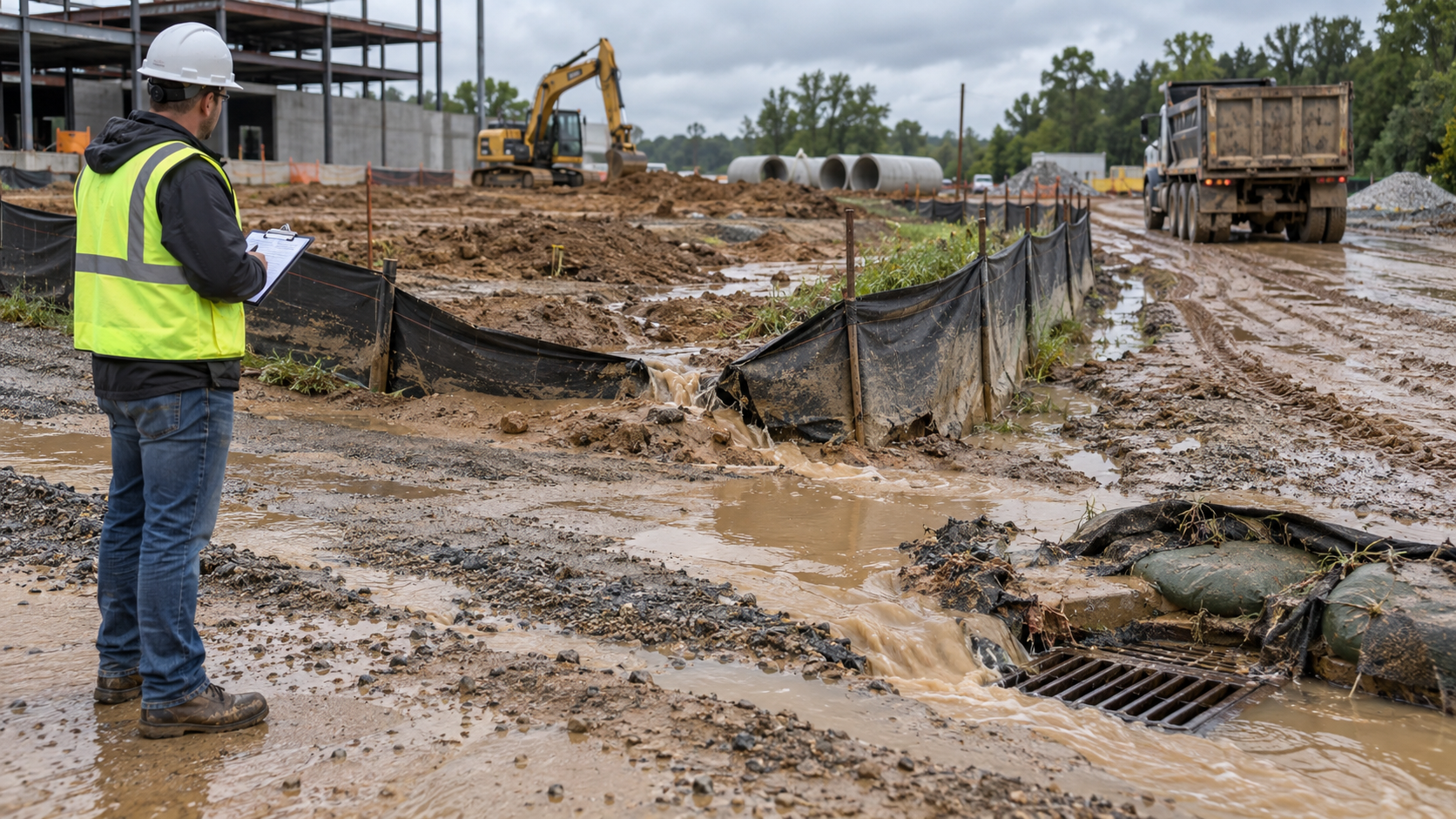
The most commonly cited SWPPP violations on construction sites are inadequate BMP maintenance, incomplete or missing inspection records, and discharges of turbid or polluted stormwater.
Each violation is independently enforceable under the Clean Water Act with civil penalties up to $25,000 per day per violation.
What makes these violations particularly costly is that they are almost always avoidable. After over a decade in the field, the most common SWPPP violations often come down to complacency, such as not updating an SWPPP or submitting an NOI too late.
A construction site manager who understands what regulators look for during a compliance inspection can prevent most SWPPP enforcement actions before they happen.

Why SWPPP Violations Are Increasing
The surge in Stormwater Pollution Prevention Plan (SWPPP) violations is primarily driven by heightened regulatory oversight and stricter compliance standards.
Both the EPA and state NPDES regulators have ramped up construction site inspections and enforcement, particularly following the implementation of the 2022 Construction General Permit (CGP).
This permit introduced tighter rules around Best Management Practice (BMP) documentation, post-storm inspection timelines, and corrective action deadlines, giving inspectors more grounds to cite violations during a single visit.
While state-level enforcement remains heaviest in high-activity areas like Pennsylvania, New Jersey, California, and Texas, the EPA has simultaneously increased direct enforcement actions in federally managed jurisdictions since the permit’s reissuance.
5 Most Common SWPPP Violations
Based on regulatory enforcement data, construction site operators most often face penalties for the following five SWPPP violations.
1. BMP Maintenance Failures
Failed or degraded BMPs are the single most cited finding in construction stormwater enforcement.
A BMP that is physically present but not functioning provides no permit protection.
The CGP requires BMPs to be properly installed, maintained, and functioning, not merely present on the site plan.
The maintenance failures regulators find most often include:
- Silt fence undermined or bypassed: Sheet flow concentrated at low points or fence gaps has cut under or around the fence, allowing sediment-laden runoff to escape without any filtration. Common after any significant storm event.
- Inlet protection displaced or clogged: Filter socks, rock-ring dams, and silt fence inserts knocked aside by maintenance equipment or clogged with debris to the point where flow is routing around the device rather than through it.
- Sediment basin or trap at or above capacity: A basin that has filled with sediment has no remaining storage volume and provides no treatment function during a rain event. The 2022 CGP requires sediment removal when the basin reaches half its design capacity.
- Stabilized construction entrance degraded: A rutted, muddy, or insufficient aggregate entrance pad is allowing mud to be tracked onto public roads, producing a direct turbid discharge to the storm sewer system.
- Temporary stabilization not applied within 14 days: Areas of disturbed soil that have been inactive for 14 or more days without temporary seeding, mulching, or an equivalent stabilization measure are in violation regardless of upcoming construction plans.
BMPs presenting imminent discharge risk must be corrected before the next storm event; other deficiencies must be addressed within 7 calendar days of identification.
Document both the deficiency and the correction in the inspection record.
2. Inadequate or Missing Inspection Records
A site with functional BMPs but missing or inadequate inspection records has no documented evidence of compliance, and the absence of records is treated as evidence of non-compliance for the periods they cover.
The CGP requires inspections at minimum every 7 calendar days and within 24 hours of any storm event producing 0.25 inches or more.
In our field experience, the most common inspection record violations include:
- Generic observations: Inspection forms that record all BMPs as ‘adequate’ without site-specific observations about each BMP’s condition, location, and any identified deficiencies.
- Missed post-storm inspections: Failure to conduct the 24-hour post-storm inspection after qualifying rainfall events is an independent violation for each missed event. Storm events are verifiable through local precipitation records, and regulators routinely cross-reference inspection records against weather data.
- Missing corrective action documentation: An inspection that identifies a BMP deficiency must document the corrective action taken and the completion date.
- Unauthorized signatory: Inspection records signed by a project manager, subcontractor, or consultant without the authority required by 40 CFR 122.22 are not valid certifications. The signatory must be a responsible corporate officer or equivalent for the operator entity.
3. Unauthorized or Turbid Discharges
A visible turbid discharge from a construction site, including water that is visibly brown, gray, or otherwise carrying suspended sediment, is a direct permit violation regardless of whether the SWPPP is otherwise in order.
These illegal discharges typically stem from perimeter BMP failures during storms, uncontained concrete washouts, untreated dewatering groundwater, or material spills entering storm drains.
4. SWPPP Not Updated to Reflect Current Site Conditions
The SWPPP is a living document that reflects current site conditions.
When grading changes drainage patterns or when a storm event reveals that existing BMPs are inadequate, the SWPPP must be amended to reflect the new conditions and the new or modified BMPs required to address them.
Regulators who observe a discrepancy between the SWPPP and field conditions have documented evidence of non-compliance regardless of how well the existing BMPs are functioning.
5. Late or Missing NOI Submission
Commencing construction before the Notice of Intent is submitted means every discharge from the site during the pre-authorization period is an unauthorized discharge.
Pre-authorization violations are among the most straightforward enforcement findings because they are established entirely from NOI submission dates and construction commencement dates, both of which are documented in public records.
The NOI must be submitted at least 7 calendar days before the first earth disturbance.
The most common scenario producing pre-authorization violations is a construction schedule that moves the commencement date earlier without a corresponding advance in the NOI submission.
How to Avoid SWPPP Violations: A Field Manager’s Checklist
Field managers can use the following checklist to identify common sources of compliance failure and implement prevention measures to avoid future ones.
| Violation Category | Prevention Measure | Frequency |
| BMP maintenance failure | Walk every BMP on the site; do not rely on subcontractor reports | Weekly + within 24 hrs of 0.25″ rain |
| Inspection records | Complete site-specific observations for each BMP; document corrective actions and dates | Every 7 days + post-storm |
| Turbid discharge | Check all perimeter BMPs and discharge points after every storm; immediately correct any breach | Post-storm, within 24 hrs |
| SWPPP out of date | Review SWPPP when site conditions change; amend before next inspection cycle | After any grading change or BMP modification |
| Pre-authorization discharge | Submit NOI at least 14 days before planned start date to allow for scheduling variability | Before any earth disturbance |
| Concrete washout | Confirm washout area is in place and accessible before every concrete pour | Before each pour |
| Temporary stabilization gap | Track the 14-day calendar on all inactive areas; apply stabilization before the clock runs out | Ongoing throughout construction |
What Happens During a Regulatory Inspection
Site managers can prepare for routine regulatory inspections by learning what regulators inspect and how they evaluate site compliance during a visit:
- SWPPP review: The inspector will ask for the SWPPP and review it for completeness, current site conditions, and whether it has been updated to reflect changes.
- Inspection record review: The inspector will review all inspection records since the last inspection, looking for documentation of post-storm inspections, site-specific observations, and corrective action completion. Missing inspections, incomplete observations, or corrective actions documented without completion are citable violations.
- Site walkthrough: The inspector will walk the site perimeter and interior, physically checking each BMP for installation quality, maintenance status, and functionality. They will check discharge points for evidence of turbid or polluted discharge.
- Photographs: Inspectors document conditions with photographs that become part of the enforcement record. A turbid discharge, a failed silt fence, or a sediment-filled basin captured in a photograph is difficult to contest.
Proactive SWPPP compliance, thorough documentation, and well-maintained BMPs will ensure smooth regulatory inspections, protect your site from steep enforcement fines, and prevent costly project delays.
FAQs
What are the most common SWPPP violations on construction sites?
Common SWPPP violations include BMP maintenance failures like undermined silt fences, incomplete inspection records with generic notes, uncontained turbid stormwater discharges, outdated written plans, and starting earth-disturbing work without an active Notice of Intent (NOI).
How much are fines for SWPPP violations?
Under the Clean Water Act, the EPA authorizes civil penalties of up to $25,000 per day per violation, which can accumulate rapidly for ongoing non-compliance. State-level penalties often equal or exceed federal caps depending on site history and actual environmental damage.
What triggers a construction stormwater inspection?
Inspections are commonly triggered by routine regulatory regional sweeps, public complaints regarding visible offsite turbidity, aerial or satellite monitoring of unpermitted land disturbance, or permit discrepancies identified after an NOI is filed.
Does a SWPPP violation always result in a fine?
No, regulatory responses range from informal warnings and Notices of Deficiency to formal enforcement orders and financial penalties. Operators who keep inspection logs up to date and correct site issues immediately are far less likely to face monetary fines.