



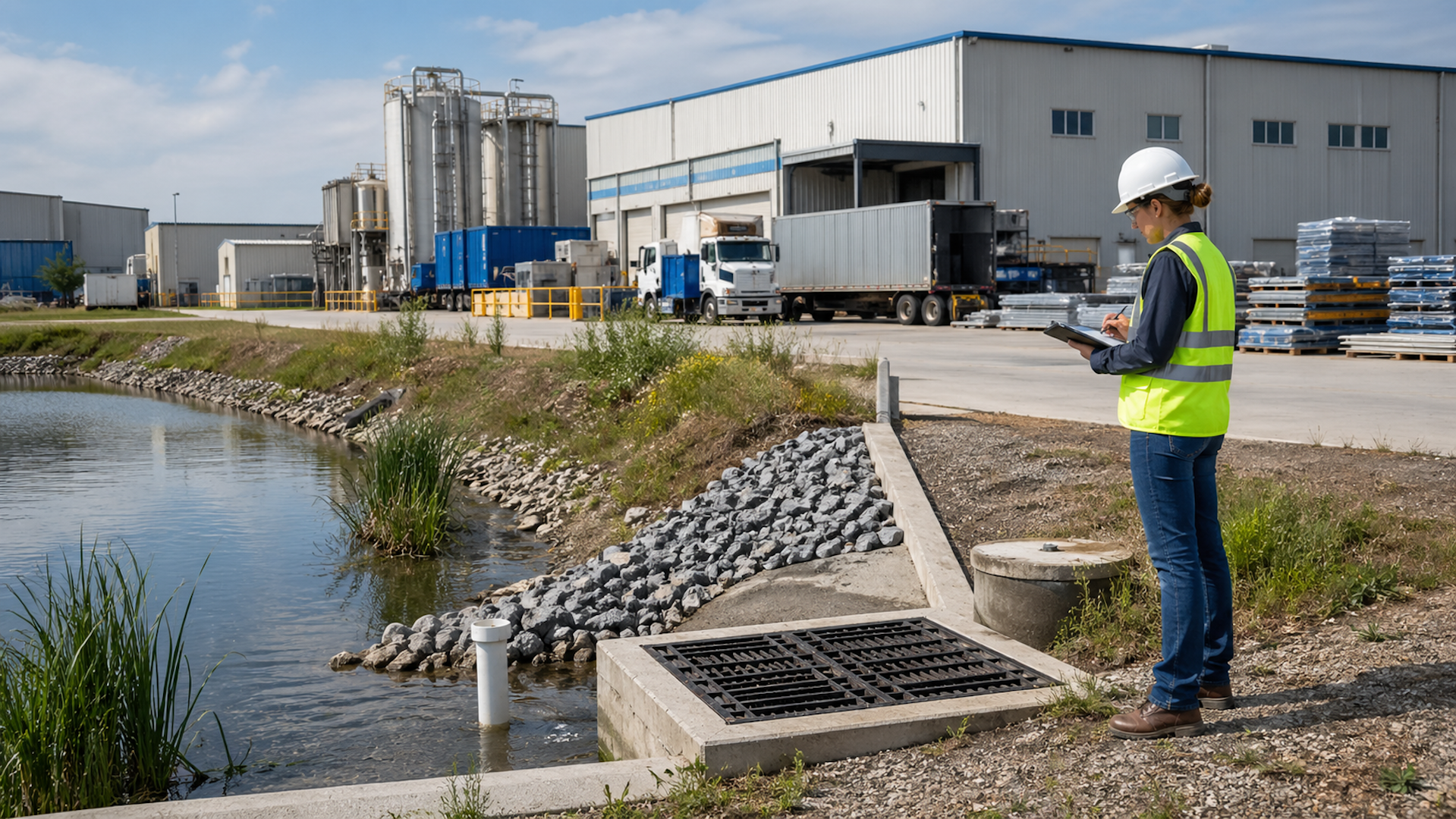
The Multi-Sector General Permit (MSGP) is a federal stormwater permit issued under the Clean Water Act that regulates stormwater discharges from industrial activities, including many types of construction and site preparation.
The purpose is straightforward: limit contamination from runoff. If your industrial activities expose materials, equipment, or disturbed soil to rainfall, you are required to obtain permit coverage and implement controls to prevent pollutants from entering nearby waterways.
Without proper controls, stormwater can carry sediment, oils, heavy metals, and construction debris into storm drains, streams, and groundwater systems.
This article explores the critical role of MSGP coverage in industrial projects, detailing which sectors are required to obtain it, the step-by-step process for compliance, and common pitfalls to avoid.

What Is the Multi-Sector General Permit (MSGP)?
The Multi-Sector General Permit (MSGP) is an NPDES permit issued under Section 402 of the Clean Water Act that authorizes stormwater discharges from industrial facilities, including industrial construction activities, into waters of the United States.
It is the primary federal mechanism for regulating industrial stormwater at over 29 different facility sectors, and non-compliance carries civil penalties of up to $25,000 per day per violation under the Clean Water Act.
The current 2021 MSGP took effect on March 1, 2021, replacing the 2015 version. The EPA proposed the 2026 MSGP in late 2024, and the 2021 permit is administratively continued for facilities with existing coverage until the new version is finalized.
Whether you are a new industrial construction operator or a permittee approaching the next cycle, understanding the MSGP’s structure, scope, and jurisdiction is essential to determining whether your discharges are legally authorized.
What Does the MSGP Cover?
The MSGP covers stormwater discharges associated with industrial activity at facilities whose Standard Industrial Classification (SIC) codes are listed in the permit’s Appendix D. It applies to 29 designated industrial sectors — labeled Sector A through Sector AC — covering manufacturing, mining, oil and gas, hazardous waste treatment, landfills, steam electric power, transportation, and construction-adjacent activities.
For industrial construction specifically, the MSGP applies when a facility’s primary industrial activity is construction-related, and the SIC code falls within a covered sector.
Stormwater runoff that contacts exposed industrial materials, equipment, or waste products at a site before discharging to a water of the United States requires permit coverage. The permit covers two types of discharge:
- Stormwater discharges: precipitation runoff that contacts industrial activity areas, storage areas, or material handling zones
- Certain non-stormwater discharges: including uncontaminated groundwater, landscape irrigation return flows, and fire hydrant flushing, under specific conditions
Note: The MSGP does not apply to construction stormwater discharges covered separately under EPA’s Construction General Permit (CGP). The CGP governs land disturbance activities of one acre or more. Industrial construction activities at a facility that also has ongoing operations may require both permits simultaneously.
Who Is Required to Obtain MSGP Coverage?
Industrial operators must obtain MSGP coverage if they discharge stormwater associated with industrial activity, as defined under 40 CFR 122.26(b)(14), to a surface water or a municipal separate storm sewer system (MS4).
The 11 categories defined in that regulation include manufacturing, mining, oil and gas extraction, hazardous waste treatment, landfills, and transportation facilities, among others.
Coverage is also required for co-located activities at a facility. If a secondary operation on-site falls within a covered SIC code and has stormwater exposure, it must be included in the permit.
Facilities that have no industrial materials or activities exposed to stormwater may qualify for a No Exposure Certification (NEC) in lieu of full permit coverage, thereby exempting them from the MSGP as long as they maintain the certified no-exposure condition.
Operators who miss the NOI submission deadline do not have authorized discharge coverage. Under the Clean Water Act, all discharges between the start of industrial activity and permit coverage authorization are unauthorized and subject to enforcement action.
Understanding Industrial Sectors Under MSGP
The Multi-Sector General Permit (MSGP) categorizes industrial activities into 29 distinct sectors, each governed by specific regulatory frameworks tailored to their unique environmental risk profiles.
The permit assigns requirements based on the typical pollutants and operational hazards associated with each industry.
- Risk-Based Categorization: Industries—ranging from Timber Products (Sector A) to Scrap Recycling (Sector N)—are subject to specialized mandates for benchmark monitoring, inspection intervals, and pollutant control measures.
- Strategic Classification: Accurate sector identification is the cornerstone of regulatory strategy. This classification dictates the technical parameters for sampling, the intensity of monitoring obligations, and the specific engineering controls required on-site.
- The Cost of Misclassification: Precision in determining your sector is vital for legal security. Misclassifying an industrial activity can result in a “technical non-compliance” status, rendering even the most robust on-site environmental controls legally insufficient under EPA scrutiny.
Which States and Jurisdictions Does the EPA MSGP Directly Govern?
The EPA directly administers the MSGP only in jurisdictions that have not received full NPDES program authorization. In the 47 states and the U.S. Virgin Islands that have been fully or partially authorized to administer NPDES programs, state agencies issue their own industrial stormwater general permits, which frequently mirror the federal MSGP but are legally distinct from it.
The following jurisdictions are governed directly by EPA’s MSGP because EPA retains NPDES permitting authority there:
| Jurisdiction | Type | EPA Primacy Status |
|---|---|---|
| Massachusetts | State | EPA is NPDES permitting authority |
| New Hampshire | State | EPA is NPDES permitting authority |
| New Mexico | State | EPA is NPDES permitting authority |
| District of Columbia | Federal district | EPA is NPDES permitting authority |
| Puerto Rico | U.S. territory | EPA is NPDES permitting authority |
| U.S. Virgin Islands | U.S. territory | Partially authorized; EPA retains primacy |
| American Samoa | U.S. territory | EPA is NPDES permitting authority |
| Guam | U.S. territory | EPA is NPDES permitting authority |
| Northern Mariana Islands | U.S. territory | EPA is NPDES permitting authority |
| Indian Country Lands | Tribal lands | EPA is NPDES permitting authority (most) |
| All other states (47) | States | State agency administers NPDES program; EPA MSGP does not apply directly |
Note: Idaho transferred NPDES permitting authority to the Idaho Department of Environmental Quality on July 1, 2021, and is no longer subject to direct EPA MSGP authority. Industrial facilities in Idaho now operate under a state permit.
How to Obtain MSGP Coverage: Step-by-Step
Securing a permit is a proactive legal requirement that ensures your industrial operations align with Clean Water Act standards. Follow these critical steps to ensure full compliance:
1. Determine Eligibility
Start by confirming that your site qualifies under MSGP and is not excluded due to location-specific restrictions, such as proximity to impaired waters or endangered species habitats.
You’ll also need to verify that you can meet effluent limitation guidelines (ELGs) and applicable water quality standards.
2. Submit a Notice of Intent (NOI)
To obtain coverage, you must submit a Notice of Intent (NOI) to the EPA or your state’s delegated authority.
The NOI includes:
- Site location and operator information
- Industrial sector classification
- Description of activities and discharge points
- Certification of compliance intent
Coverage is not active until the NOI is accepted, so timing matters.
3. Develop a Stormwater Pollution Prevention Plan (SWPPP)
The SWPPP is the core of MSGP compliance. It documents how your site will prevent stormwater contamination.
A strong SWPPP includes:
- Site maps with drainage patterns and discharge points
- Inventory of potential pollutant sources
- Description of control measures (BMPs)
- Inspection and maintenance schedules
- Spill prevention and response procedures
This is not a static document; it must reflect actual site conditions at all times.
4. Implement Best Management Practices (BMPs)
To maintain Multi-Sector General Permit (MSGP) compliance, operators must deploy a combination of structural and non-structural Best Management Practices (BMPs). These are the primary defenses used to minimize the discharge of pollutants into local watersheds.
Standard Industrial BMPs include:
- Erosion & Sediment Controls: Installation of silt fences, sediment basins, and stabilized construction entrances to prevent off-site tracking.
- Operational Controls: Utilizing covered storage for raw materials and implementing secondary containment for hazardous fuels and chemicals.
- Site Maintenance: Establishing rigorous housekeeping protocols and routine debris removal to eliminate source pollutants before they contact stormwater.
Effectiveness is measured by performance, not just presence. A poorly maintained BMP is considered a compliance failure and can be cited as a permit violation during inspections.
5. Conduct Inspections and Monitoring
The MSGP framework requires active oversight through mandatory site evaluations and analytical water sampling.
- Routine Analytical Monitoring: Beyond visual checks, many sectors require benchmark monitoring. This involves laboratory analysis of stormwater runoff to ensure concentrations of pollutants, such as suspended solids, heavy metals, or pH levels, remain below EPA-defined thresholds.
- Comprehensive Inspections: Site walkthroughs must verify the integrity of all BMPs, identify emerging pollutant sources, and ensure that all storage areas remain secure and leak-free.
- Corrective Actions: If an inspection reveals a deficiency, the permit requires immediate documentation and a set timeline for remediation to maintain good standing.
6. Maintain Documentation and Reporting
In the eyes of regulatory auditors, “if it wasn’t documented, it didn’t happen.” Administrative record-keeping is often where industrial operators face the highest risk of fines, as incomplete records are frequently treated with the same severity as physical non-compliance.
Maintaining a centralized and living Stormwater Pollution Prevention Plan (SWPPP) is essential, as it must reflect all current site conditions, personnel changes, and updated Best Management Practices.
Alongside the SWPPP, operators must archive comprehensive inspection logs, maintenance work orders, and certified laboratory monitoring results.
Finally, these records culminate in the submission of an Annual Report to the EPA or state authority, which serves as the formal summary of the facility’s findings, corrective actions, and overall permit performance for the year.
MSGP and NOI Application Timeline
Obtaining MSGP coverage requires submitting a Notice of Intent (NOI) through EPA’s NPDES eReporting Tool (NeT-MSGP). The NOI must be submitted electronically unless the applicable EPA Regional Office grants a waiver. Coverage is not authorized until the NOI is reviewed and approved.
| Milestone | Timing / Deadline |
| Develop or update SWPPP | Before submitting NOI — must be complete first |
| Submit NOI (new facility) | At least 30 days before stormwater discharge begins |
| Submit NOI (existing 2015 MSGP facility) | Was due May 30, 2021; now governed by 2026 MSGP renewal cycle |
| Permit coverage begins | After NOI reviewed and approved; typically 30 days from submission |
| Quarterly visual examinations | Every quarter throughout permit coverage |
| Benchmark monitoring (most sectors) | Quarterly in Year 1; Year 4 monitoring also required |
| Indicator monitoring (PAHs, pH, TSS, COD) | Bi-annually in Years 1 and 4 for applicable facilities |
| Annual report submission | January 30 following each calendar year of coverage |
| Permit renewal cycle | Every 5 years (current: 2021 MSGP; proposed 2026 MSGP pending) |
What Are the Monitoring Requirements Under the MSGP?
Monitoring requirements under the MSGP vary by sector. The 2021 permit applies benchmark monitoring to approximately 55% of covered facilities—those in sectors whose activities are associated with documented pollutant discharge risks.
Benchmark monitoring does not function as an effluent limit: exceedances trigger corrective action requirements, not automatic violations.
Quarterly Visual Examinations
All sectors except Sector S require quarterly visual examinations of stormwater discharges. Visual examinations are conducted by qualified personnel and documented in the SWPPP. Results are not submitted to the EPA but must be retained on-site and available for inspection.
Benchmark Monitoring and AIM
For applicable sectors, benchmark monitoring is required quarterly throughout the first year and again in the fourth year of permit coverage. Benchmark values were updated in the 2021 permit; the aluminum, copper, selenium, and cadmium thresholds were revised based on EPA water quality criteria, while the iron and magnesium benchmarks were removed due to a lack of documented toxicity data.
When benchmark exceedances occur, the 2021 MSGP’s three-level Additional Implementation Measures (AIM) framework governs the required response:
| AIM Level | Trigger | Required Response |
| Level 1 | First benchmark exceedance | Review SWPPP and control measures; identify and implement needed changes; continue monitoring |
| Level 2 | Second exceedance while Level 1 is active | Implement additional control measures beyond the SWPPP baseline; document all actions |
| Level 3 | Third exceedance while Level 2 is active | Implement permanent structural controls or treatment controls; notify EPA Regional Office |
A single sample that exceeds the benchmark threshold by more than 4x also triggers AIM Level 1, even if fewer than four quarterly samples have been collected.
Indicator Monitoring
New to the 2021 MSGP, certain facilities must conduct bi-annual indicator monitoring for polynuclear aromatic hydrocarbons (PAHs) in the first and fourth years of coverage. Quarterly indicator monitoring for pH, total suspended solids (TSS), and chemical oxygen demand (COD) is also required for applicable sectors.
Indicator monitoring is report-only; exceedances do not result in violations or trigger AIM.
The Importance of MSGP Compliance
Navigating the Multi-Sector General Permit (MSGP) for industrial construction requires more than checking regulatory boxes. It demands active management of stormwater risks, accurate documentation, and consistent execution in the field.
Projects that treat compliance as a core operational function—not just an environmental requirement—are far more likely to avoid violations, delays, and unnecessary costs.
If your project involves exposed materials, active industrial processes, or long-term site development, MSGP compliance should be built into your workflow from day one.
FAQs
What is the difference between the MSGP and the Construction General Permit (CGP)?
The MSGP covers stormwater discharges from ongoing industrial operations across 29 sectors. The CGP covers stormwater from land disturbance activities of one acre or more. An industrial facility that is also undergoing construction may need both the MSGP for its operational discharges and the CGP for construction-related earth disturbance. If construction at the site is incidental to the industrial operation (not a primary ground-disturbing activity), the MSGP alone typically covers it.
Do all states use the EPA MSGP?
No. EPA’s MSGP applies directly only in jurisdictions where EPA retains NPDES permitting authority: Massachusetts, New Hampshire, New Mexico, Washington D.C., Puerto Rico, several U.S. territories, and most Indian Country lands. The 47 authorized states issue their own industrial stormwater general permits. Most state permits mirror the federal MSGP in structure but are legally separate documents with state-specific requirements.
What is the SWPPP and when does it need to be updated?
The SWPPP (Stormwater Pollution Prevention Plan) is the site-specific compliance document outlining pollution sources, BMPs, and monitoring procedures. It must be developed before submitting the NOI and updated whenever site conditions change — including new construction, changes to industrial processes, new materials stored outdoors, new outfalls, or following benchmark exceedances. Under the 2021 MSGP, it must also be made publicly available.
What happens if a benchmark is exceeded?
Benchmark exceedances do not result in automatic violations. They trigger the AIM (Additional Implementation Measures) framework. Level 1 requires SWPPP review and corrective action. Level 2 requires additional control measures. Level 3–triggered by a third exceedance–requires permanent structural or treatment controls and notification to the EPA Regional Office. Monitoring must continue until benchmark levels are consistently met.
How long is the MSGP valid and what happens when it expires?
The MSGP is issued on a five-year cycle. The 2021 MSGP expired February 28, 2026. Under the Administrative Procedure Act (40 CFR 122.6), the permit is administratively continued for facilities with existing coverage until a new version is finalized. EPA proposed the 2026 MSGP in late 2024. Facilities covered prior to the expiration date remain authorized to discharge under the continued 2021 permit until the 2026 MSGP is finalized and they obtain new coverage.
Can an industrial facility transfer MSGP coverage to a new owner?
No. MSGP coverage cannot be transferred. When a facility changes ownership, the current operator must submit a Notice of Termination (NOT) to terminate their coverage, and the new operator must submit a new NOI and develop or update the SWPPP before beginning discharge. Any gap in coverage during the transition constitutes an unauthorized discharge.
What is indicator monitoring and how does it differ from benchmark monitoring?
Indicator monitoring measures pollutants (pH, TSS, COD, and PAHs for applicable sectors) on a report-only basis. It does not have threshold values that trigger violations or AIM requirements. Its purpose is to give EPA data to assess pollutant levels across sectors and inform future permit revisions. Benchmark monitoring, by contrast, has established numeric threshold values: exceedances trigger AIM, though they are not direct violations.
What is a No Exposure Certification and when does it apply?
A No Exposure Certification (NEC) is an alternative to full MSGP coverage for facilities that can certify that no industrial materials or activities are exposed to stormwater. If a facility stores all materials indoors, covers all process areas, and prevents all stormwater contact with industrial operations, it may qualify for NEC status. The NEC must be re-certified periodically and immediately revoked if exposure conditions change.