



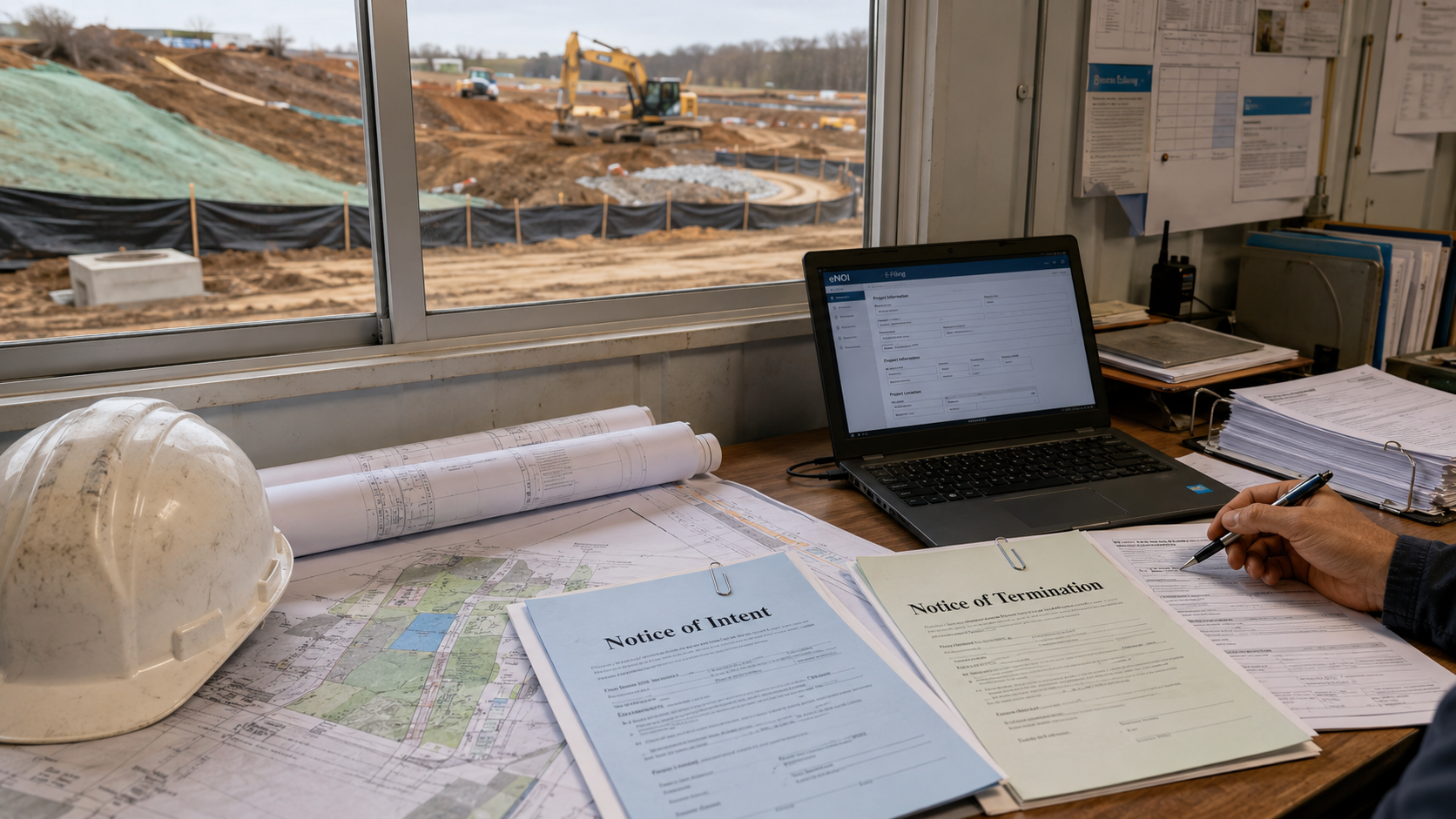
A Notice of Intent (NOI) formally establishes permit coverage under EPA’s Construction General Permit before land-disturbing activity begins on a qualifying construction site.
A Notice of Termination (NOT) formally ends that coverage once the site has achieved final stabilization and all permit conditions have been met.
Both are legal compliance filings.
Submitting the wrong information in an NOI, submitting it too late, or failing to submit a NOT under proper conditions are all permit violations under the Clean Water Act.
Civil penalties for NPDES permit violations can reach $25,000 per day per violation.
The forms themselves are not complex, but the conditions that must be met before each can be submitted are specific enough that errors are common–particularly on the NOT side where operators often assume final stabilization is complete before it actually meets the permit standard.
This guide covers who must submit, what information each form requires, the step-by-step submission process through EPA’s eReporting Tool, state-specific variations, and the importance of working with a qualified SWPPP specialist.

Who Must Submit an NOI Under the CGP?
An NOI is required from any operator of a construction site that disturbs one or more acres of land, or that disturbs less than one acre but is part of a larger common plan of development or sale that will disturb one or more acres in total.
Under EPA’s 2022 Construction General Permit, an “operator” is any entity that has day-to-day operational control over construction plans and specifications (including the ability to change them).
In practice, this means both the owner and the general contractor are typically co-operators required to obtain individual permit coverage—not a single NOI shared between them.
When Must the NOI Be Submitted?
The EPA requires you to submit your Notice of Intent (NOI) CGP at least seven calendar days before starting any initial land-disturbing activities like clearing or grading.
Compliance programs typically submit the NOI two to three weeks in advance to allow time to finalize the Stormwater Pollution Prevention Plan (SWPPP) and resolve any errors.
Once submitted, permit coverage is automatically granted seven days after the EPA acknowledges receipt, unless you are otherwise notified of a delay or denial.
What Information Does the NOI Require?
The 2022 CGP NOI requires the following categories of information. Each must be accurate and complete; incomplete submissions do not establish permit coverage.
| NOI Category | Required Information & Documentation |
|---|---|
| Operator & Project ID | Legal name of the entity, contact information, project type, and precise latitude/longitude coordinates. |
| Site & Water Data | Total and disturbed acreage, specific receiving water bodies, and 303(d) impairment status. |
| Environmental Clearances | Documented screening eligibility for Endangered Species and Historic Properties. |
| SWPPP Certification | Signed confirmation that a complete SWPPP is finalized and accessible on-site. |
| Authorized Signatory | Legally binding electronic signature from a responsible corporate officer or general partner. |
How to Submit the CGP NOI: Step-by-Step
The EPA requires electronic NOI submission through the NPDES eReporting Tool (NeT), accessible at EPA’s eReporting website. Paper submissions are not accepted for CGP NOIs under the 2022 permit.
- Create an EPA CDX Account: Register at cdx.epa.gov at least 48 hours before filing to allow time for identity verification.
- Access the NeT Tool: Log in to your Central Data Exchange (CDX) account and select the Construction General Permit (CGP) program.
- Start the NOI: Select “New Submission” and fill out the form sections in sequential order.
- Enter Site Coordinates: input your exact latitude and longitude to ensure the automated environmental screenings run correctly.
- Complete Screenings: Run the integrated eligibility checks for Endangered Species and Historic Properties.
- Identify Receiving Waters: Use the built-in WATERS database to link correct, official names of local water bodies.
- Sign and Certify: Confirm your SWPPP is finalized, then have an authorized corporate officer electronically sign the document.
- Submit and Track: Save your NeT confirmation number; permit coverage automatically activates seven calendar days later.
When Can a Notice of Termination (NOT) Be Submitted? Final Stabilization Requirements
A Notice of Termination can be submitted only after all conditions for termination under the 2022 CGP have been met.
The 2022 CGP establishes three alternative bases for NOT submission, of which the first is applicable to most construction projects:
- Final Stabilization Achieved: Achieve either 70% uniform perennial vegetative density compared to pre-disturbance levels, apply permanent structural stabilization (like concrete or riprap), or completely return the site to its original tilled agricultural use.
- Another Operator Has Assumed Control: Submit an NOT identifying the new operator once they have officially obtained their own individual CGP coverage, legally ending your liability for that area.
- Residential Lot Transfer: File an NOT for individual residential lots after selling them to homebuilders, provided the buyer has permit coverage or the lot disturbs less than one acre outside of a larger common plan.
How to Submit the CGP NOT: Step-by-Step
NOT submission follows the same NeT process as the NOI, using the same CDX account credentials and the same eReporting Tool.
- Log In to NeT: Access the NPDES eReporting Tool (NeT) via your EPA CDX account and select the CGP program.
- Locate Your NOI: Find your active project record using its tracking number and select “Submit NOT”.
- Select Your Basis: Choose your reason for termination (final stabilization, operator transfer, or residential lot transfer).
- Provide Documentation: Enter your specific site closure data, such as vegetative cover percentages or the new operator’s permit info.
- Clear BMPs & Violations: Certify that all temporary stormwater controls are removed and any inspection violations are resolved.
- Sign and Submit: Have your authorized signatory sign electronically through CDX and save your confirmation number.
CGP NOI and NOT Key Deadlines and Requirements
The following table is designed to help operators maintain proper CGP compliance by meeting specific NOI and NOT timelines.
| Requirement | Timing / Standard | Applies To |
|---|---|---|
| NOI submission | At least 7 calendar days before construction commencement | All operators on CGP-covered sites |
| Permit coverage effective date | 7 calendar days after the EPA acknowledges the complete NOI | All operators |
| SWPPP completion | Must be complete before NOI submission | All operators |
| Endangered species / historic properties screening | Must be completed before NOI submission | All operators |
| NOT submission — final stabilization | After 70% vegetative cover or equivalent permanent stabilization achieved on all disturbed areas | Most construction projects |
| NOT submission — operator transfer | After receiving operator obtains own CGP coverage | Sites with operator transfers |
| Inspection records retention | 3 years after permit termination | All operators |
| SWPPP records retention | 3 years after permit termination | All operators |
State Permit Programs: Key Differences from the CGP
Forty-seven states administer their own NPDES construction stormwater permits and do not use EPA’s CGP or the NeT submission system.
In those states, the applicable state permit governs NOI and NOT submission.
The most common differences from the federal CGP include:
- Different disturbance thresholds: Most states use the one-acre threshold, but some states have lower thresholds for certain project types or locations. California’s Construction General Permit applies to sites disturbing one or more acres and includes a risk-level determination that affects permit conditions significantly.
- State-specific submission portals: State NOI submissions typically go through state agency portals rather than EPA’s NeT. California uses the State Water Board’s Storm Water Multiple Application and Report Tracking System (SMARTS). Pennsylvania uses the DEP’s e-Permitting system.
- Different pre-submission lead times: State permits vary in the required advance submission period. Pennsylvania’s E&S permit program requires submission and approval before earth disturbance. It is not a general permit with automatic coverage, but rather a permit-by-rule that requires individual plan approval for most projects.
- Additional inspectors certification requirements: As covered in the SWPPP inspection guide, several states require state-specific inspector certifications that have no parallel in the federal CGP.
- Different final stabilization standards: Some states use standards that differ from the CGP’s 70% vegetative cover requirement. Texas uses site-specific stabilization standards set by the permit. California requires both a vegetation standard and a blower door equivalent for testing stabilization on some project types.
Navigating the complexities of CGP compliance, state-specific permits, and precise environmental screenings leaves zero margin for error.
Filing mistakes or delayed submissions can lead to severe Clean Water Act violations and costly penalties of up to $25,000 per day.
Partnering with an experienced SWPPP professional is the safest way to guarantee your project stays fully compliant from groundbreaking to final stabilization.
FAQs
How far in advance must an NOI be submitted before construction?
The 2022 CGP requires submitting a Notice of Intent (NOI) at least 7 calendar days before starting construction activity (defined as the first land disturbance, like initial grading or clearing). To allow time for corrections, most programs submit NOIs 2 to 3 weeks before the planned start date.
Coverage is automatically granted 7 days after the EPA acknowledges a complete NOI, unless you are notified otherwise.
Does each operator on a site need to submit a separate NOI?
Yes. Every operator on a CGP-covered site must submit their own individual NOI.
For example, a project with both a property owner and a general contractor requires two separate submissions. One operator’s coverage does not extend to anyone else, and acting under a co-operator’s filing without your own submission is a violation.
What happens if I submit an NOI after construction has already started?
Any stormwater discharges that occur before your permit coverage becomes effective (7 days after a complete NOI is acknowledged) are unauthorized. Under the Clean Water Act, each day of unauthorized discharge is a separate violation subject to civil penalties of up to $25,000 per day.
If you start late, submit the NOI immediately and implement full compliance; the violation record for the early period cannot be erased or retroactively corrected.
What is the final stabilization standard required before submitting a NOT?
To submit a Notice of Termination (NOT), all construction must be complete, and all disturbed areas not covered by buildings or pavement must achieve a uniform perennial vegetative cover with a density of at least 70% of the pre-disturbance native vegetation.
Patchy growth or areas failing to meet this uniform standard across the full footprint do not qualify.